





It seems like I just started this year's installment of this series, yet by the end of you reading this installment, we will already be halfway through with this year's Bold Prediction series. I hope you have enjoyed the 20 previous predictions as well as the 10 you will read in this article, which includes the players from the table below. The ADP data cited in this piece comes from the 21 Draft Champions drafts from the past 30 days:
Player | ADP | Min Pick | Max Pick | # Picks |
|---|---|---|---|---|
68 | 58 | 83 | 21 | |
124 | 102 | 142 | 21 | |
190 | 167 | 218 | 21 | |
209 | 191 | 251 | 21 | |
325 | 297 | 365 | 21 | |
Victor Scott II | 336 | 293 | 391 | 21 |
361 | 321 | 401 | 21 | |
482 | 427 | 555 | 21 | |
494 | 355 | 645 | 21 | |
561 | 480 | 696 | 21 |
Let's begin with the most recent big-name signing in Chicago, which is also where I made one of my biggest misses in the 2025 Bold Prediction series.
Chicago
Last Year: Pete Crow-Armstrong is not a top-60 outfielder (1 star)
This Year: Alex Bregman does not hit 20 homers
Projection | HR | RBI | R | SB | BA |
|---|---|---|---|---|---|
RotoWire | 22 | 74 | 78 | 2 | .266 |
Steamer | 23 | 77 | 85 | 3 | .260 |
THE BAT | 23 | 83 | 80 | 2 | .251 |
OOPSY | 18 | 76 | 81 | 3 | .258 |
I can already hear, "Hey, OOPSY has him below 20 homers, so is this really a bold prediction?" I submit that it
It seems like I just started this year's installment of this series, yet by the end of you reading this installment, we will already be halfway through with this year's Bold Prediction series. I hope you have enjoyed the 20 previous predictions as well as the 10 you will read in this article, which includes the players from the table below. The ADP data cited in this piece comes from the 21 Draft Champions drafts from the past 30 days:
Player | ADP | Min Pick | Max Pick | # Picks |
|---|---|---|---|---|
68 | 58 | 83 | 21 | |
124 | 102 | 142 | 21 | |
190 | 167 | 218 | 21 | |
209 | 191 | 251 | 21 | |
325 | 297 | 365 | 21 | |
Victor Scott II | 336 | 293 | 391 | 21 |
361 | 321 | 401 | 21 | |
482 | 427 | 555 | 21 | |
494 | 355 | 645 | 21 | |
561 | 480 | 696 | 21 |
Let's begin with the most recent big-name signing in Chicago, which is also where I made one of my biggest misses in the 2025 Bold Prediction series.
Chicago
Last Year: Pete Crow-Armstrong is not a top-60 outfielder (1 star)
This Year: Alex Bregman does not hit 20 homers
Projection | HR | RBI | R | SB | BA |
|---|---|---|---|---|---|
RotoWire | 22 | 74 | 78 | 2 | .266 |
Steamer | 23 | 77 | 85 | 3 | .260 |
THE BAT | 23 | 83 | 80 | 2 | .251 |
OOPSY | 18 | 76 | 81 | 3 | .258 |
I can already hear, "Hey, OOPSY has him below 20 homers, so is this really a bold prediction?" I submit that it is, because it is both the only projection system which I have seen which has him below 20 homers and it also incoporates a primary part of the foundation of this particular prediction.
Bregman currently sits seventh in ADP at third base right alongside Eugenio Suarez and just ahead of Jordan Westburg, and I would still want Bregman out of that trio of players. Yet that decision is more about the uncertainty surrounding the players after that, as Bregman easily represents the last of the "solid" third baseman. It's the type of situation that would drive overpaying in an auction format for the last best guy at a position for the multiple owners who put themselves in that situation.
Bregman has hit 20 homers in every full season he has played in since 2017, peaking at 41 during the fun times of 2019. He had a three-year run of 20-plus home runs before the injury-shortened 2025 season in Boston, which limited him to 18 home runs in 495 plate appearances. The signing in Chicago, as well as his plate discipline, would assuredly put him high in the lineup and lock him in for another 650-plus plate appearances as long as his body holds up. Bregman was raking at a .299/.385/.553 clip before his late-May severe quad strain but fell off to a .250/.338/.386 line once he returned to the lineup just before the midsummer classic. It is understandable that Bregman struggled upon his return after the long layoff, and one could argue he may not have been 100 percent healed given how slowly he was moving around the bases when he did reach base. All of that is in the rearview mirror now, but there are new circumstances in play.
Wrigley Field is a finicky monster because, while it has the reputation of being a hitters' park, it all depends on the winds off Lake Michigan on any given day. Last year's Kyle Tucker fantasy managers scoff at the thought the place is a hitters' park after watching Tucker suffer there, but the park treats righties and lefties differently. Using the Park Factors leaderboard at BaseballSavant with three-year rolling factors, we see Wrigley Field was in the bottom half of the league for lefty offense, but it was the second-worst of the 28 major-league parks (sorry Steinbrenner & Sutter) for overall right-handed park factors, albeit slightly above average for home runs. Jumping over to the adjusted home run section of Bregman's player profile page shows he woud have hit 25, 28, and 26 home runs at Wrigley from 2022 to 2024. However, that was a younger version of Bregman, and father time comes for every player's bat speed in his thirties.
Bregman was still able to homer 26 times in Houston in 2024 despite his 22nd percentile bat speed, but the Crawford Boxes certainly helped, as 16 of his 26 homers that season came in Houston. Isaac Paredes learned the hard way; Wrigley is not terribly forgiving to dead pull hitters, so I would expect Bregman to lose some of those homers he hits right down the line the past two seasons to become doubles or outs:

Getting back to OOPSY, those projections from Jordan Rosenblum recently came out, and I like them because they incorporate a weighted consideration of bat speed. As Tom Tango has taught us, the aging curve for bat speed begins to see an accelerated plunge down charts between ages 32 and 33; Bregman turns 32 on opening weekend this season.

Don't get me wrong; I still would love to have Bregman on multiple teams this season as long as the price is right, but I am looking at this as four-category production because his running days are long over, and I believe this is the start of a new era for the player.
Last Year: Matthew Boyd is a top-100 pitcher (5 stars)
This Year: Cade Horton is not a top-100 pitcher
Projection | W | SV | ERA | WHIP | K |
|---|---|---|---|---|---|
RotoWire | 11 | 0 | 2.69 | 1.08 | 110 |
Steamer | 8 | 0 | 4.34 | 1.33 | 117 |
THE BAT | 8 | 0 | 4.13 | 1.21 | 100 |
OOPSY | 9 | 0 | 3.93 | 1.27 | 127 |
Horton is currently the 79th pitcher off the board in drafts over the last month after an impressive freshman campaign which saw him win half of his 22 starts with stellar ratios to boot. Even a jump over to his player page here at RotoWire shows a lot of green in the right areas, so why am I pessimistic on Horton avoiding a sophomore slump? It all comes down to two favorite pitching metrics for me: K-BB% and Stuff+.
K-BB% is a a strong leading indicator of overall pitching because it is a strong reflection of the true skills of a pitcher. Can they strike hitters out, and can they avoid putting those batters on base freely via the walk? There is a strong correlation with subsequent success using K-BB%, though in the research Eno Sarris did in doing Stuff+ work, he found it is an even more powerful predictive pitching statistic than K-BB%, even in small sample sizes.
Horton's 13.4 percent K-BB% last season was decidedly middle of the pack for all pitchers with at least 110 innings worked, as he ranked 60th among the 118 pitchers in that group. Horton thrived at Wrigley Field as a lefty with its favorable conditions, pitching to a 1.63 ERA and 0.94 WHIP around his 13.6 percent K-BB%. His ratios rose to a 3.59 ERA and 1.21 WHIP on the road while the K-BB dipped only slightly to 13.3 percent.
Horton's Stuff+ grade was 96 last season (100 is average), with a 101 Location+ and a 97 Pitching+. If I were to find all qualified pitchers with a K-BB% no higher than 13.5% and a sub-100 Stuff+ grade from 2025, this is what that list looks like, sorted by the top 10 K-BB% in descending order:
| PITCHER | 2025 K-BB% | 2025 STUFF+ | 2026 ADP |
|---|---|---|---|
| Zac Gallen | 13.4% | 93 | 192 |
| Cade Horton | 13.4% | 96 | 167 |
| Mitch Keller | 13.2% | 95 | 345 |
| Yusei Kikuchi | 13.0% | 95 | 351 |
| Simeon Woods Richardson | 13.0% | 88 | 363 |
| Zack Littell | 12.9% | 85 | 432 |
| Noah Cameron | 12.8% | 94 | 256 |
| Matthew Liberatore | 12.7% | 96 | 432 |
| Quinn Priester | 12.6% | 98 | 282 |
| Colin Rea | 12.5% | 95 | 469 |
If you sort that chart by ADP (go ahead, click) you will see that Horton is going two to three rounds earlier than anyone else depending on whether you are in a 12 or 15-team league. The market that is currently drafting Horton must be projecting him to take another step forward while mostly fading the rest of the league, but based on what exactly?
I would be remiss if I did not mention Horton's massive workload jump which saw him go from 34.1 innings in 2024 to 147 innings last season, one where he pitched mostly as a 23-year-old. We do not often see a 328 percent workload increase on a young arm, so I will gladly take my chances with some of the other pitchers on this list with similar profiles before paying the current market price on a young arm coming off a heavy workload increase that also shows some regression in other indicators on his profile.
Cincinnati
Last Year: Gavin Lux is a top-15 second baseman (2 stars)
This Year: Sal Stewart is a top-15 first baseman and wins Rookie of the Year
| projection | HR | RBI | R | SB | BA |
|---|---|---|---|---|---|
| RotoWire | 12 | 38 | 42 | 6 | .236 |
| Steamer | 12 | 43 | 41 | 5 | .272 |
| THE BAT | 16 | 57 | 50 | 5 | .263 |
| OOPSY | 15 | 54 | 48 | 6 | .252 |
This prediction will not only require Stewart to jump up four to five rounds by ADP, but it will also require him to crack the starting lineup for the Reds, because he currently does not have a clear path to a starting role judging by our depth charts or by Roster Resource. Both sources show Stewart as a secondary option on the infield or at DH, but this is a case where I believe the talent wins out and Stewart forces his way into the lineup. Admittedly, this also involves me shunning a player in Lux who I hyped last year, but Lux showed us what he was (and was not) last season, and I don't believe he should be a roadblock to Stewart's presence in the lineup.
Stewart, after all, is the top prospect in the organization, and he quickly showed why when he was promoted last season:
Stewart turned 22 this past month, so watching him hit .309/.383/.524 with 20 homers, 78 runs, 80 RBI and 17 steals with a 15.6 percent strikeout rate as a 21 year-old across two levels of the minors was quite impressive given he was one of the youngest players in both Double-A and Triple-A.
The depth chart uncertainty is currently suppressing Stewart's market value because he would easily be going inside the top 150 if the Reds came out today and said he was going to be in the everyday lineup. The park conditions are always favorable at home, and Stewart's overall plate discipline could also lead to him hitting higher in the lineup. Stewart did not even attempt a steal at the major-league level, so wishcasting a double-digit steal season would be unwise, but one year removed from watching single-digit sprint speed players such as Josh Naylor and Juan Soto surprise us, anything is possible. All aboard this rookie hype train as the talent will eventually win out with Stewart bringing home the hardware.
Last Year: Nick Lodolo is a top-60 pitcher (5 stars)
This Year: Brady Singer is a top-100 pitcher
Projection | W | SV | ERA | WHIP | K |
RotoWire | 11 | 0 | 4.27 | 1.29 | 158 |
Steamer | 11 | 0 | 4.40 | 1.33 | 164 |
THE BAT | 9 | 0 | 4.80 | 1.35 | 153 |
OOPSY | 11 | 0 | 4.35 | 1.32 | 162 |
Singer is currently 127th on the ADP charts going 75 picks later than Noah Cameron, who is currently the 100th pitcher on the chart. The former org mates could be swapping spots when it's all said and done, as I see some upside in Singer with some of the changes he made last season as he looked to extend his success from 2024.
Singer was a surprise contributor in wins last season, winning 14 of his 32 starts with a 14.4 percent K-BB% and decent ratios. We witnessed Singer continue his sinker-first method of pitching, but he has adjusted his secondaries to incorporate more sweepers after adding the pitch in 2024 and has shelved his ineffective changeup, which was nothing more than a show-me pitch to lefties. The increased utilization of the sweeper helped Singer limit the damage inflicted on him by lefties last season. You can see how he really started to embrace the sweeper as the year went on last season:
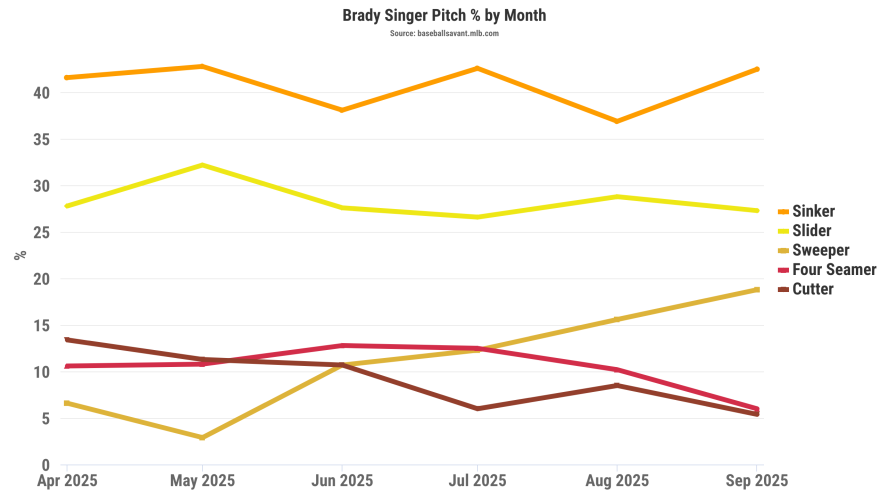
Singer improved from a first half which saw him post a 12.1 percent K-BB% while the league hit .251 off him with a 1.35 WHIP to a second half K-BB% of 17.8 percent, a .217 batting average against and a 1.08 WHIP. Singer is now throwing five different pitch types against lefties, four of which are used at least 10 percent of the time, making him less susceptible to the opposite-handed damage which plagued him earlier in his career while his sinker/slider/sweeper approach to righties continues to be a tough matchup for righties around the league. Just look at some of the swings and pitches in this video:
Simply put, this is an undervalued pitcher on the market because he lacks the big fastball, but the second-half changes as well as his improvements against lefties have me excited for a successful 2026 season and I'd happily take him on multiple rosters at this current market price.
Milwaukee
Last Year: Caleb Durbin is a top-350 player (4 stars)
This Year: Brice Turang is the best second baseman in fantasy baseball and a top-25 overall player
| Projection | HR | RBI | R | SB | BA |
|---|---|---|---|---|---|
RotoWire | 11 | 60 | 75 | 33 | .259 |
Steamer | 14 | 62 | 77 | 26 | .261 |
THE BAT | 14 | 64 | 80 | 31 | .252 |
OOPSY | 15 | 65 | 77 | 30 | .256 |
There was a popular social media meme recently which involved this particular soundbite, and that's all that comes to mind when I put Turang's 2024 batting profile (left) next to his 2025 profile (right):
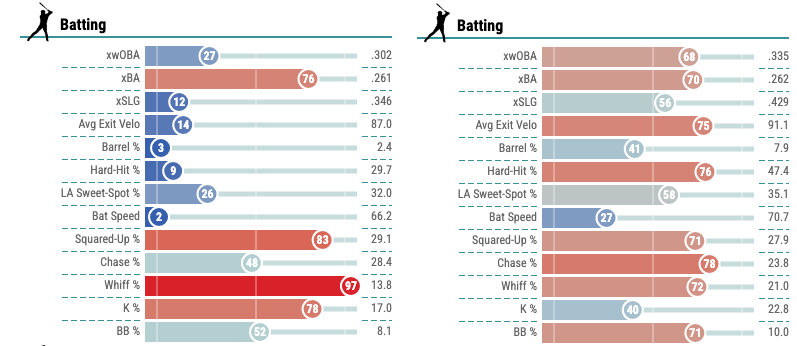
Turang made some early changes to his swing to generate more bat speed, essentially unwinding everything he said he was not during a May 2024 podcast appearance. Some of the swings and results in this long highlight video were really impressive as well:
However, what really got my attention in the offseason studying was some work by Ben Clemens back in September which showed how Turang was fifth in the league by exit velocity on opposite field aerial contact in a group consisting of James Wood, Shohei Ohtani, Nick Kurtz and Pete Alonso. The only thing Turang has in common with those players is they all play baseball, but every one of them dwarfs Turang physically and yet he had the same opposite field aerial exit velocity as Alonso. In short, Turang is built like Luis Arraez but drives the ball, in some ways, like Alonso. You learn something new every day.
Turang's changes at the plate helped take what was consistently below-average exit velocity to above-average exit velocity in a home park which favors such hitting:

Turang is currently third on the second base ADP chart, but he is 40 picks behind Jazz Chisholm Jr. and another two rounds behind Ketel Marte, who we now know is staying in Arizona as the club took him off the block while also adding Nolan Arenado to the lineup. I believe Turang, with his continued improvement and a full season of Jackson Chourio setting the table in Milwaukee, is well-positioned to exceed his 2025 production and lead the pack at second base this season. #MVT?
Last Year: DL Hall is a top-150 pitcher (1 star)
This Year: Chad Patrick is a top-100 pitcher
Projection | W | SV | ERA | WHIP | K |
RotoWire | 4 | 0 | 3.73 | 1.29 | 148 |
Steamer | 8 | 0 | 4.46 | 1.30 | 128 |
THE BAT | 9 | 0 | 4.23 | 1.22 | 132 |
OOPSY | 10 | 0 | 3.95 | 1.24 | 140 |
Patrick is the 141st pitcher off the board going just after starters Payton Tolle, Yusei Kikuchi, and Luis Gil and just in front of Simeon Woods-Richardson, Michael Wacha, and David Peterson. I believe he should be higher, and higher than fellow rookie Cade Horton.
Milwaukee comes into the season with a rotation of Freddy Peralta, Brandon Woodruff, Jacob Misiorowski, Quinn Priester, with Chad Patrick also projected to make the rotation. There are daily Peralta trade rumors at this point, with Logan Henderson, Robert Gasser and Tobias Myers among other names competing for a rotation spot in camp should one be available. Patrick pitched to a 3-7 record with a 3.72 ERA, a 16.1 percent K-BB% and a 1.32 WHIP over his first 16 starts in 2025 before being sent down to make room for the returning Woodruff. Patrick returned in mid-August to work as a swingman, striking out 32 batters in 25 innings while allowing 20 hits with a 31.1 percent strikeout rate and a 21.4 percent K-BB%.
The late version of Patrick saw him throwing more cutters and four-seamers out of the pen, and that duo of pitches each had a whiff rate on them greater than 30 percent. That cutter was something he worked on in Nashville as it was not present before his demotion, but we saw it as well as his overall stuff look very good late in the year, particularly in October:
It would not be surprising to see Milwaukee deal Peralta as his contract gets out of their comfort zone and to see Patrick take that step forward as the remaining arms in the rotation all take one step up in the rotation. I feel he has earned the chance to show whether those late gains in 2025 can translate into increased 2026 success in a full-time rotation role and cannot help but be sucked in by how much his stuff improved once he returned from Nashville:

Pittsburgh
Last Year: Spencer Horwitz is a top-200 overall player (2 stars)
This Year: Joey Bart is a top-24 catcher
projection | HR | RBI | R | SB | BA |
|---|---|---|---|---|---|
RotoWire | 8 | 35 | 34 | 3 | .238 |
Steamer | 7 | 30 | 31 | 2 | .239 |
THE BAT | 9 | 37 | 39 | 1 | .236 |
OOPSY | 9 | 35 | 38 | 1 | .236 |
I stated earlier in this series that I include picks for all league types; this would be one of those. If you are not in a two-catcher NL-only league or doing 50-round drafts, you can likely gloss over this one and move on. However, I'm not yet ready to quit on the former second-overall draft choice who is now out of options and is potentially the starting catcher for Pittsburgh.
Bart and Henry Davis will be battling it out for the catching position this spring, and Davis is admittedly the better of the two behind the plate in most aspects. However, Davis has been a 53 wRC+ bat in 660 career plate appearances at the big-league level, so his bat opens up an opportunity for Bart, who has at least been better than league average offensively each of the past two seasons, and last year's big improvement in his walk rate helped push his value up.
Bart has evolved himself into a plate discipline God, and I encourage you to read into what Davy Andrews at Fangraphs found when looking into Bart's changes in his plate discipline. Bart still shows above league-average bat speed and his rolling hard hit rate chart is very interesting for someone going 39th in the catcher pool over the past month:

The catching picks over the past few years have been the tougher ones to materialize, so I've efforted to limit how frequently I go to the position. Last season, I used Ivan Herrera for the Cardinals because I was intrigued by the offensive profile, fully understanding that he was the lesser of the two options the Cardinals had behind the plate but betting that his offense would win out. I am making the same statement here and have already added Bart in the 40th round of one league as my fourth catcher and hope to add him on a couple more before the season begins.
Last Year: Braxton Ashcraft is a top-250 pitcher (3 stars)
This Year: Carmen Mlodzinski is a top-175 pitcher
Projection | W | SV | ERA | WHIP | K |
RotoWire | 1 | 0 | 3.45 | 1.23 | 64 |
Steamer | 4 | 0 | 4.12 | 1.36 | 66 |
THE BAT | 4 | 0 | 4.34 | 1.34 | 62 |
OOPSY | 2 | 0 | 3.77 | 1.30 | 73 |
Last year, I tabbed Ashcraft to break through the noise in Pittsburgh and leapfrog the other bigger names on the list, and it worked out well. This year, traffic is still crowded in Pittsburgh, at least by name value. Skenes is a first-round pick, but no other starter goes in the top 150 overall, so in uncertainty once again lies opportunity. Mlodzinski has a chance to take another step forward this season to capitalize on his second-half success.
Mlodzinski got off to a terrible start in 2025, going 1-4 over his first nine starts with a 5.67 ERA and a 1.61 WHIP, which earned him a trip down to Indianapolis. He returned a month later, working out of the pen as a multi-inning guy, and looked much different picking up four wins while pitching to a 2.12 ERA and 1.10 WHIP while bringing his K-BB% from 8.3 percent to 19.2 percent. He came back from the minors with a new curevball and rapidly increased the use of his splitter. He evolved into throwing six different pitch types to righties and lefties, and four of his pitches have above-league average Stuff+ grades along with triple-digit grades in Stuff+, Location+, and Pitching+.
Highlights, by their nature, all look terrific, as the editors are very selective to what they utilize, but Mlodzinski certainly passes the eye test in this highlight video. It's easy to see why his strikeout rate continued to grow as the season went on last season:

This, too, would be something more for NL-only managers as well as draft-and-hold formats, but deeper mixed leaguers should strongly consider Mlodzinski as a reserve option to use off the bench or potentially more if his second-half evolution was a sign of what is to come for a more competitive team in 2026.
St. Louis
Last Year: Ivan Herrera is a top-10 catcher (4 stars)
This Year: Victor Scott II leads the NL in stolen bases
| projection | HR | RBI | R | SB | BA |
|---|---|---|---|---|---|
RotoWire | 10 | 48 | 59 | 33 | .213 |
Steamer | 7 | 37 | 44 | 26 | .227 |
THE BAT | 6 | 35 | 63 | 32 | .217 |
OOPSY | 8 | 45 | 59 | 38 | .222 |
I am well aware that Scott has hit .206/.283/.293 in his 191-game major-league career. I am also well aware that the Cardinals are in a full rebuild and, rumor has it, have already been eliminated from postseason play before the first game has been played. This, my friends, will be the land of opportunity for one or more players in 2026, and I believe Scott is going to take full advantage of this as his speed and defense are things the club will want in the lineup as they try to figure out whether the young man can be everyday player for them once they reach contender status again by the end of the decade.
It's important to underscore just how wide open things are in St. Louis for fantasy purposes. Not one single player on the roster has an ADP below 170 over the last month, and only Ivan Herrera and Alec Burleson even have a minimum pick below 150. By ADP purposes, the Cardinals are summarily ignored until the 11th or 12th round of a 15-team draft. I look up and down the roster and depth chart and simply do not see anyone who will challenge Scott for his time in center field, so there is no downside into leaving him out there on a daily basis in the ninth spot of the lineup to let him do as he wishes with his speed when he reaches base. After all, his 89 percent success rate stealing bases at the major-league level has certainly earned him that right.
He was working on such things in the second half as he greatly reduced his swing-and-miss rate compared to the earlier part of the season:
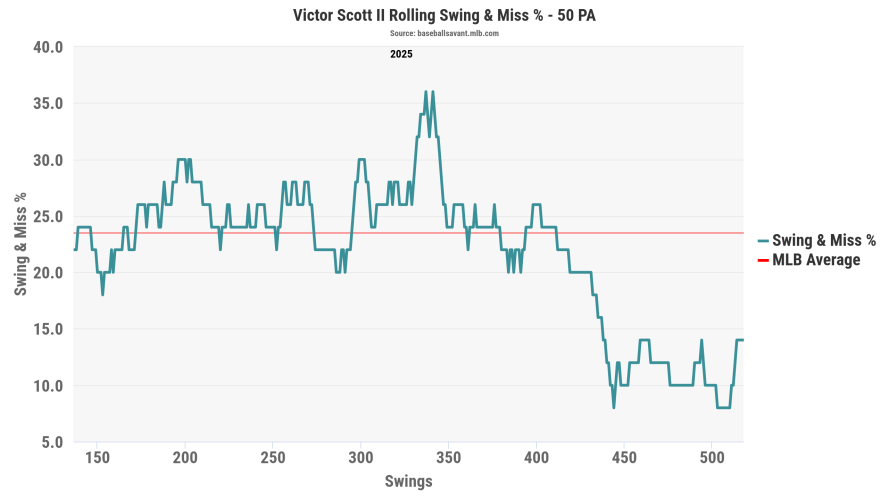
That improvement got lost in his ugly .174/.274/.239 line, which reduced his stolen bases from 26 chances in the first half to just 12 in the second half. I fully admit the flaws in this player, but the speed and defense will afford him more opportunities than the rest of his offensive profile would get in another situation. He finished sixth in steals for the National League last season with much less playing time than those in front of him. Put me down for 50 steals this season, with room for more.
Last Year: Quinn Mathews is a top-120 pitcher (1 star)
This Year: Matt Svanson leads the Cardinals in saves
Projection | W | SV | ERA | WHIP | K |
RotoWire | 0 | 0 | 2.70 | 1.01 | 70 |
Steamer | 3 | 6 | 3.84 | 1.34 | 59 |
THE BAT | 2 | 0 | 3.33 | 1.18 | 47 |
OOPSY | 3 | 6 | 3.70 | 1.31 | 64 |
I mentioned this situation in a late 2025 piece, but the numbers say Svanson is the best option in this pen based on controllable skills by the pitcher and overall grades. Depth charts and ADP charts do not reflect this, so use this confusion as an opportunity to make a bet on Svanson's skills winning out:
| PITCHER | IP | FA | SI | FC | SL | CV | CH | STUFF+ | LOC+ | PIT+ | K-BB% |
|---|---|---|---|---|---|---|---|---|---|---|---|
| JoJo Romero | 61 | 89 | 113 | 68 | 113 | 103 | 90 | 106 | 101 | 107 | 10.2% |
| Matt Svanson | 60.1 | 90 | 103 | 99 | 125 |
|
| 110 | 100 | 106 | 20.5% |
| Riley O'Brien | 48 |
| 116 |
| 96 | 131 | 97 | 113 | 94 | 108 | 11.6% |
O'Brien is the first reliever off the board on this team at pick 240, with Romero going at 463 and Svanson at 481. If I'm sniffing around in the late rounds or reserves looking for a closing option, I'm looking for someone to step up in this bullpen, and I always lean to the skills winning out. I like a lot of what I see here:

and here: